
“Stay here” sounds so clear to us. To our son, it meant nothing, because it never told him where to be.
If your child runs off when you say it, you know the feeling. Your heart jumps, your eyes search, and your feet move before your mind does. We lived with that for a long time. This is what helped our son stay close to us in public, one small job at a time.
Telling a child to “stay” does not say where to be or what to do. We gave our son small jobs instead: holding a book, carrying a bag, pushing the cart, writing a list. We also gave him a spot to stand in. With patience and consistency, the running faded as he got older.
Why did “stay” not work for our son?
At first, we said what most parents say. “Stay here.” “Don’t go far.” “Wait for me.” None of it worked.
Here is what we learned. “Stay” does not tell our son where to be. It does not tell him what to do with his body, his hands, or his eyes. For a child with no sense of danger or direction, an empty word is an open door.
So we stopped asking him to stay. We started giving him something to do.
What was our first win?
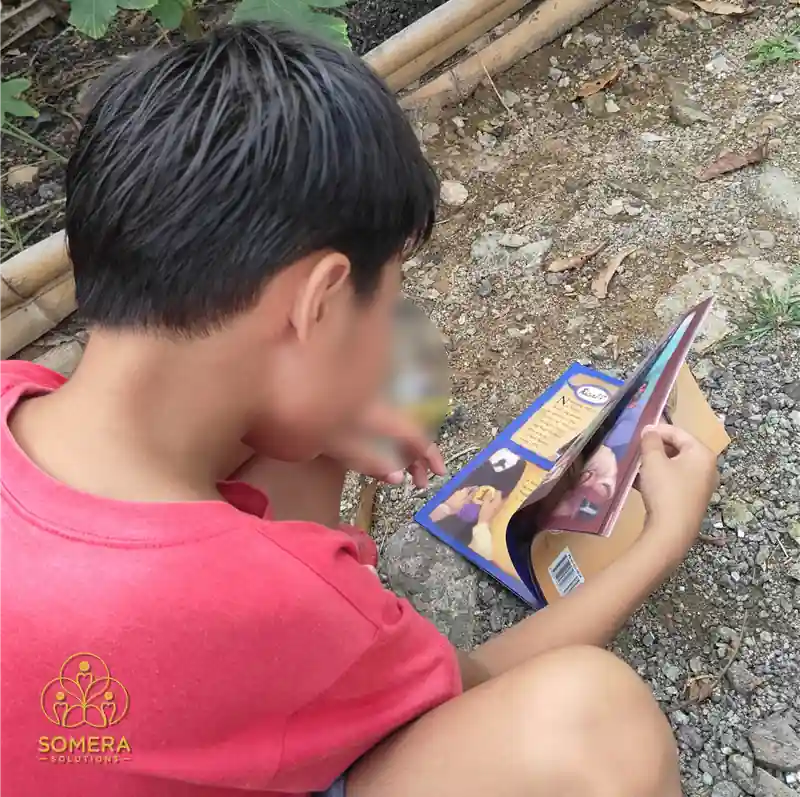
It came on the first day of school. We were waiting for the Uber, and we told him we were going to school. He sat on our couch with a small storybook and simply waited. It was such a small thing, but for us it was a big win.
Right after that, we waited about 15 minutes outside the school gate for it to open. He sat on a chair, holding his book, and waited again. Another win.
A book is not a real job. But it showed us something important. As long as he was holding something, he could wait.
What are the five small jobs?
From there, we built on it, one job at a time. Each job gave his hands something to hold and gave his mind a reason to stay close.
- Job 1: A small storybook. This is for waiting. It was our starting point, and it is still the easiest one to try.
- Job 2: His own bag. When we flew home to the province, we let him bring his own bag and carry his own things. That was the start of bigger jobs.
- Job 3: The cart. In the city, most of our trips were to the grocery. We let him hold the cart and push it.
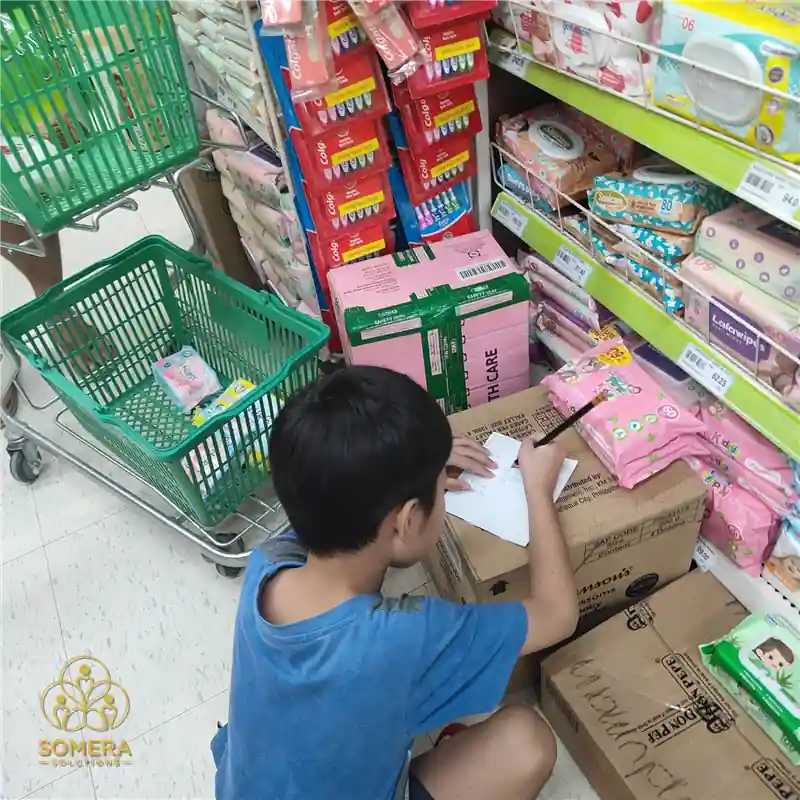
- Job 4: A shopping list. Before we left for the grocery, we let him write about 10 things we planned to buy. I had my own full list, so his was only for him. In the store, he checked each item off. That kept him busy. He stopped roaming and checking every other shelf. Later, we let him get the items on the full grocery list, with our help.
- Job 5: Carrying what we buy at the wet market. After we moved to the province, we brought him to the wet market all the time. He carries what we buy, such as half a kilo of pork, vegetables, spices, or bread.
We always keep the items light. Our son always has our support, and we never leave him behind.
How do you teach a child to stand in one spot?
Carrying something helps when we are moving. But some moments need standing still.
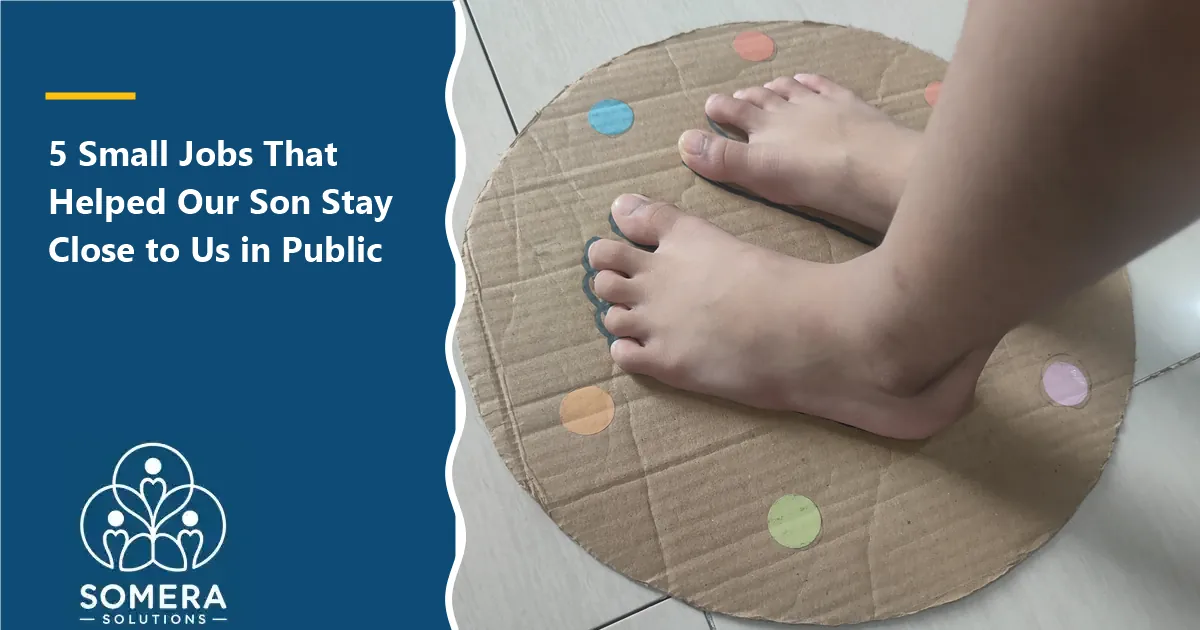
At home, when we were still in the city, we made a cardboard mat with two feet drawn on it. He stands on it when he reads, sings, or presents something for school. Without a spot, he keeps roaming around. With the mat, his feet know where to be.
Think of the painted lanes on a road. A lane marker does not shout at the cars. It simply shows where to be. The mat works the same way for our son.
We used the same idea in public. At the airport, we asked him to stand inside one floor tile. Three minutes is a long time for a child who wants to move, and we were proud of every second. If he stepped out before we said he could, we guided him back to the same square.
As he grew older, we let him explore more. Once he could answer to his name and knew what to do, he came back to his spot when we called.
What do you do when your child does not want to carry or stay?
At first, he did not want to carry anything. He would drop it, push it away, sit down, and run. Pulling him by the hand only made it worse. It turned into a tug of war and caused a scene, and he kept escaping.
So we changed what we did. I took him by the shoulder and guided him back to his spot. We did not use the word “stay.” We said, “You need to be inside the square for one minute.” Then we grew it to two minutes.
We also learned something about his bag. When it was light, he moved around a lot. But when it was a little heavier than he liked, he tended to stay in one place. It was a test, but it was never too heavy for him. Light and heavy were even some of the first opposite words he learned.
We told him the consequence, calmly and ahead of time: “If we do not wait, we will not be able to ride the airplane or the boat.” That worked well for us.
Now, at the market, we say, “Please carry this one,” and he does. It took time, but it got easier.
This is where persistence comes in. We stayed consistent, and we did not give in to his whims. My husband, Marvin, has a funny way of saying it: “Why would we give in to a little kid when we have been on this planet for forty years?” We laugh every time, and it reminds us to stay calm and firm.
Calmly, we stood our ground. Every time he left his spot, we guided him back, in the grocery, at the airport, and everywhere else.
What changed?
It did not happen overnight, and it took a long time. But as he got older, the running faded, and then it mostly stopped.
These days, we can walk to our small neighborhood store, the “tindahan,” side by side. He runs a little, jumps, and hops, but he always comes back to me and holds my hand. I was so happy the first time. That walk is why I wrote this article.
Every child is different. This is what we chose for our son. If your child is not there yet, that is okay. Go back one job and try again another day. Near roads, parking lots, and crowded places, always hold your child’s hand. If you worry about your child’s sense of danger or safety, please talk to a licensed professional. Home practice can sit beside that help. It does not replace it.
If your child learns best by doing, our post on helping a hands-on learner begin reading and writing may help too. And our post on how to start home therapy shows how we pick one small goal at a time.
If you want gentle steps in one place, our free guide has them. Our free resources page has more ideas to try.
Common questions
Why does my child run away when I let go of their hand?
Some children do not yet sense danger or direction, or an open space is simply exciting. Hold hands near roads and parking lots, and talk to a licensed professional about any safety worries.
What can a child do while waiting?
Give your child something to hold, such as a small book, their own bag, the cart, or a list. As long as their hands and mind are busy, they can wait.
How long does it take to teach a child to stay close?
For us it took a long time, with many repeats. The running faded as he got older. Every child is different, so go at your own pace.
Want a gentle next step?
Our free 14-day guide walks you through simple steps, one small day at a time.
Get the free guideRead next
- 5 Small Steps That Helped Our Son Pee in the Toilet Without Fear
- 5 Everyday Sounds That Led to Meltdowns for Our Son (and What We Did)

Iryne is a mama and the creative force behind Somera Solutions. With a background in engineering and over 10 years of technical writing, she shares simple, gentle steps for families supporting a child’s communication and early learning at home. She and her husband, Marvin, homeschool their son on their farm in Kiblawan, Davao del Sur, The Philippines.