
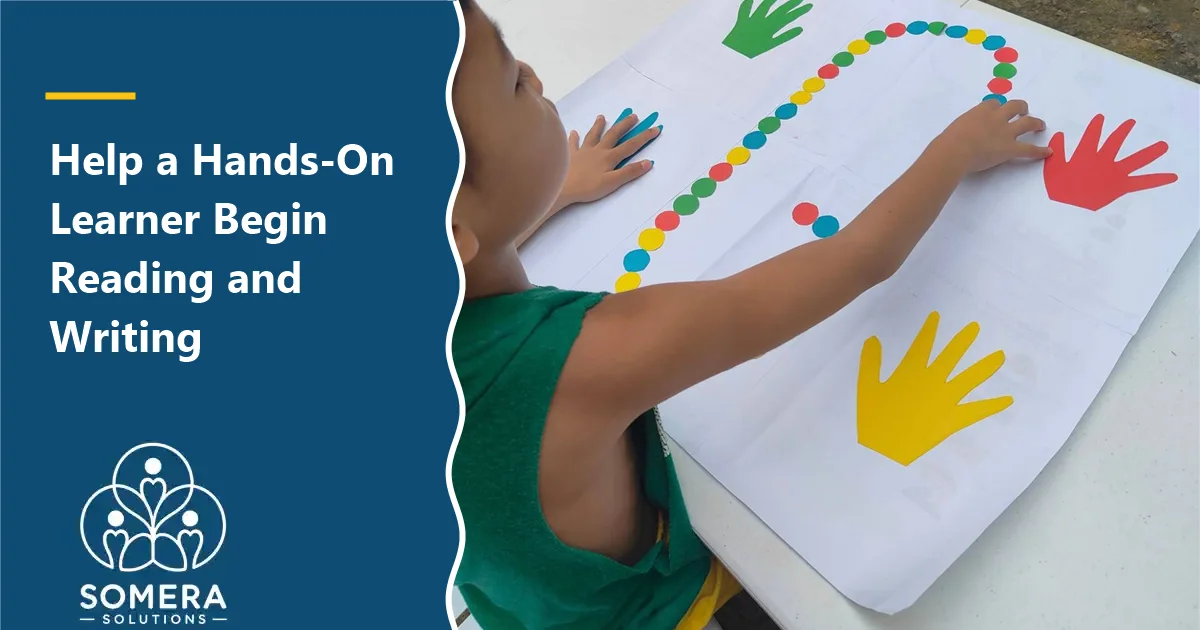
The day I made him a color-coding activity, our son sat. Really sat. His hands were busy and his brain was so focused on solving it that he forgot to wiggle away.
It was only a path drawn on paper, with colored shapes to follow in order from START to END. But it changed how we think about sitting.
How do you help a hands-on learner begin reading and writing? Most of our brain-boosting activities are movements, so we also needed activities that teach him to sit. We made them with paper and patterns: a path of colored dots (the cover photo, where he reaches across a long paper with colored paper hands around it), the dot and color challenge, and the color-coding path, a row of colored circles from START to END. He then made his own version, with a red circle, orange dots, a yellow triangle, a green square, a blue pentagon and a purple hexagon. A few minutes of hands-on pattern work teaches his body to settle down and his brain to work. This is our experience, not a promise.
What did we get wrong about sitting?
For a long time, we believed what most of us were taught: sit down first, then learn.
Our son is a hands-on learner. He learns best when he is moving, touching and doing. So when we asked him to sit and write, he would not. When we asked him to sit and read, he would not either. He kept moving. He stood, he wandered, he came back, and he left again.
The sitting was what he did not want, and because of that, his reading and writing stalled.
“Hands-on learner” is our own word for what we see at home. It is not a label from a test. It simply means he learns best when his body is busy.
If this sounds like your child, you are not doing it wrong. Some children need a different way to begin. Not sure how your child communicates? Our post on how to see how your child communicates is a good first step.
What did we notice with the color-coding activity?
One day I made him a color-coding activity. It was a path on paper with colored circles, and he had to follow them in order from START to END.
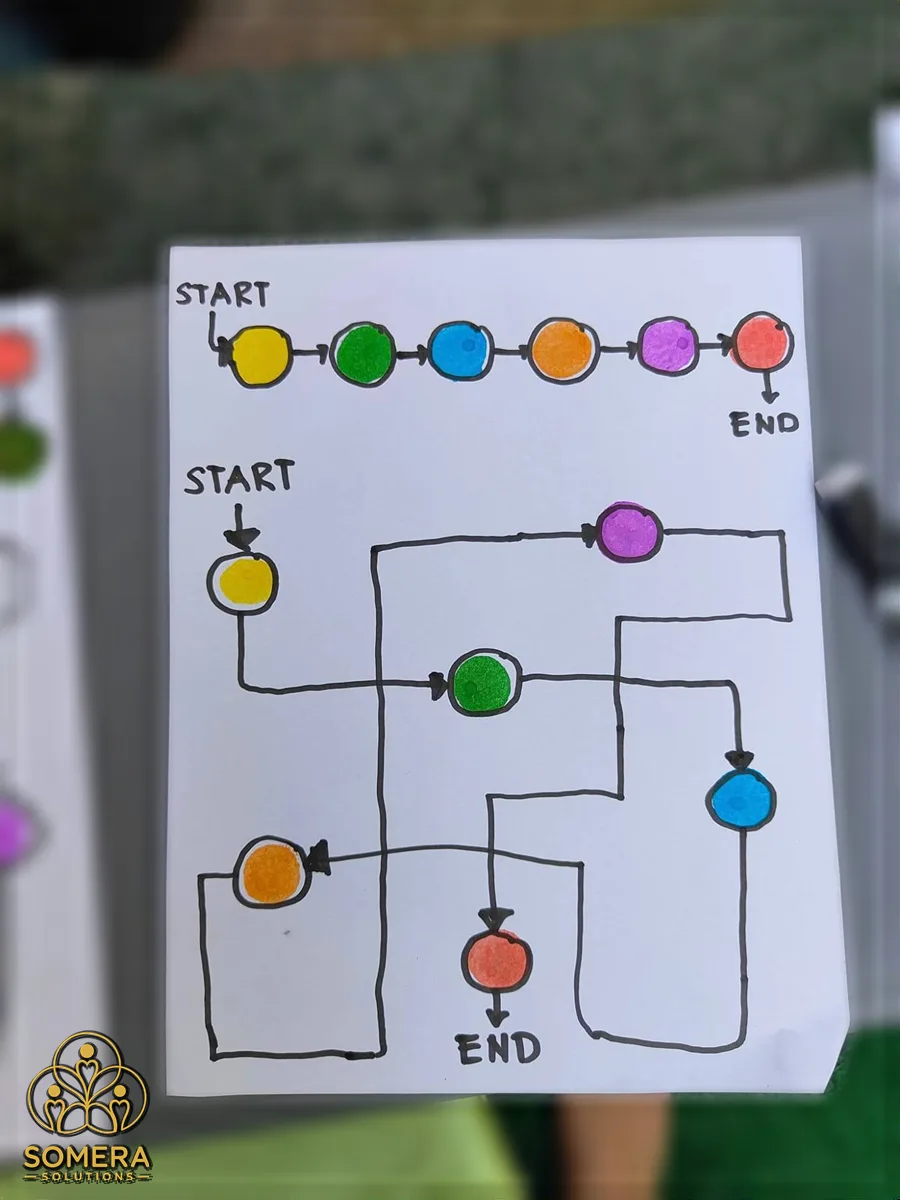
He sat. Best of all, he stayed with it. His hands were busy, and his brain was busy solving it, so there was no room left for wiggling away.
What happened next
Then he did something we did not expect. He made his own version of it, a path on paper with colored shapes in order: a red circle, orange dots, a yellow triangle, a green square, a blue pentagon and a purple hexagon, from START to END.
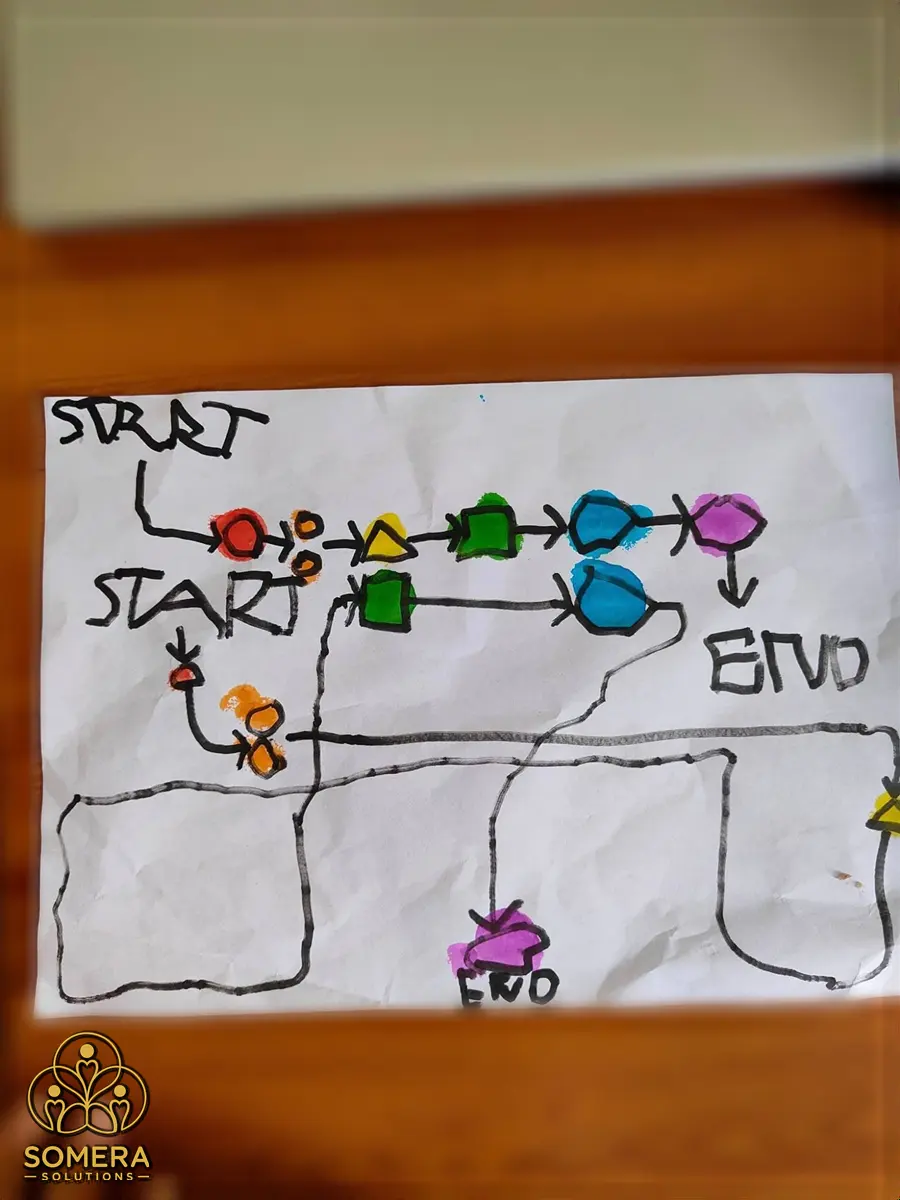
That told us something. He can sit, but he just needs a reason to, and a task that gives his hands and his brain something to do. Movement and a hands-on job came first, and the sitting followed on its own.
What are brain-boosting activities?
This is the idea behind our morning sessions. Later, I learned that these are called brain-boosting activities.
Four paper and pattern activities we use
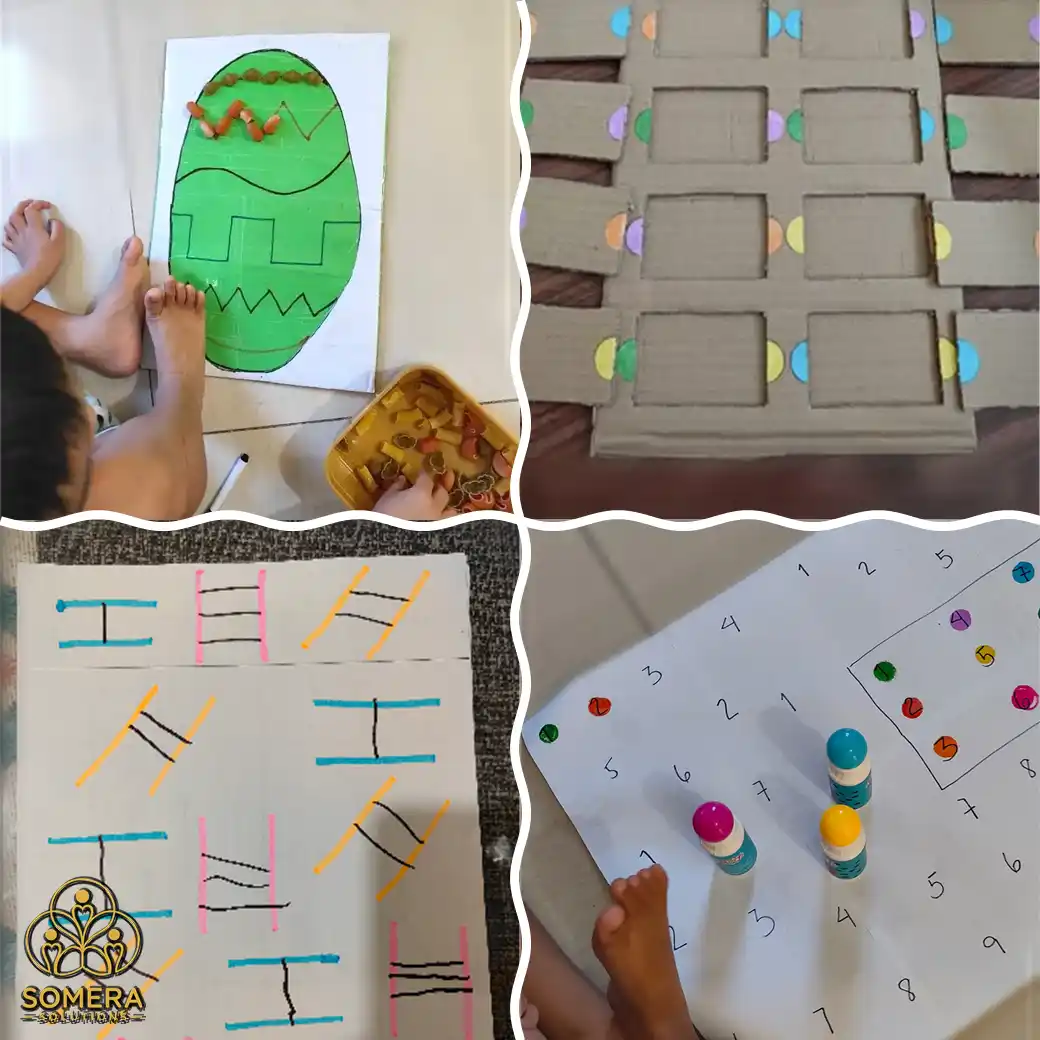
Most of our brain-boosting activities are movements, like the dead bug, the wheelbarrow walk and animal walks. But movement alone does not teach him to sit. So we also made activities with paper and patterns, and we do one each morning before we open a book or pick up a pencil. Here are four of ours:
- Pasta egg: a big green paper egg with pattern lines to follow, like zigzags, waves and squares. He lays pasta pieces along the lines, one by one.
- Color-matching board: a cardboard board with sliding strips. Colored dots sit at the ends of the strips, and he matches the colors.
- Letter patterns: pairs of colored lines going up and down (pink), across (blue) and slanted (orange). He draws black lines between each pair, which builds up toward the letters of his name initials.
- Dot and color challenge: a long paper of numbers on the floor. He stamps a colored dot on each number with dot markers.
Why we do them first
Their job is simple: to help us begin. The movements get his body going. The paper and pattern activities teach his body to settle down and his brain to work, and that is how he learns he needs to sit. They are initiation, or pre-academic, activities. They are not a lesson and they are not a test.
Think of warming up the engine before a drive. You do not turn the key and speed away. You let the engine warm up first. Movement first, then the work.
How the token chart fits in
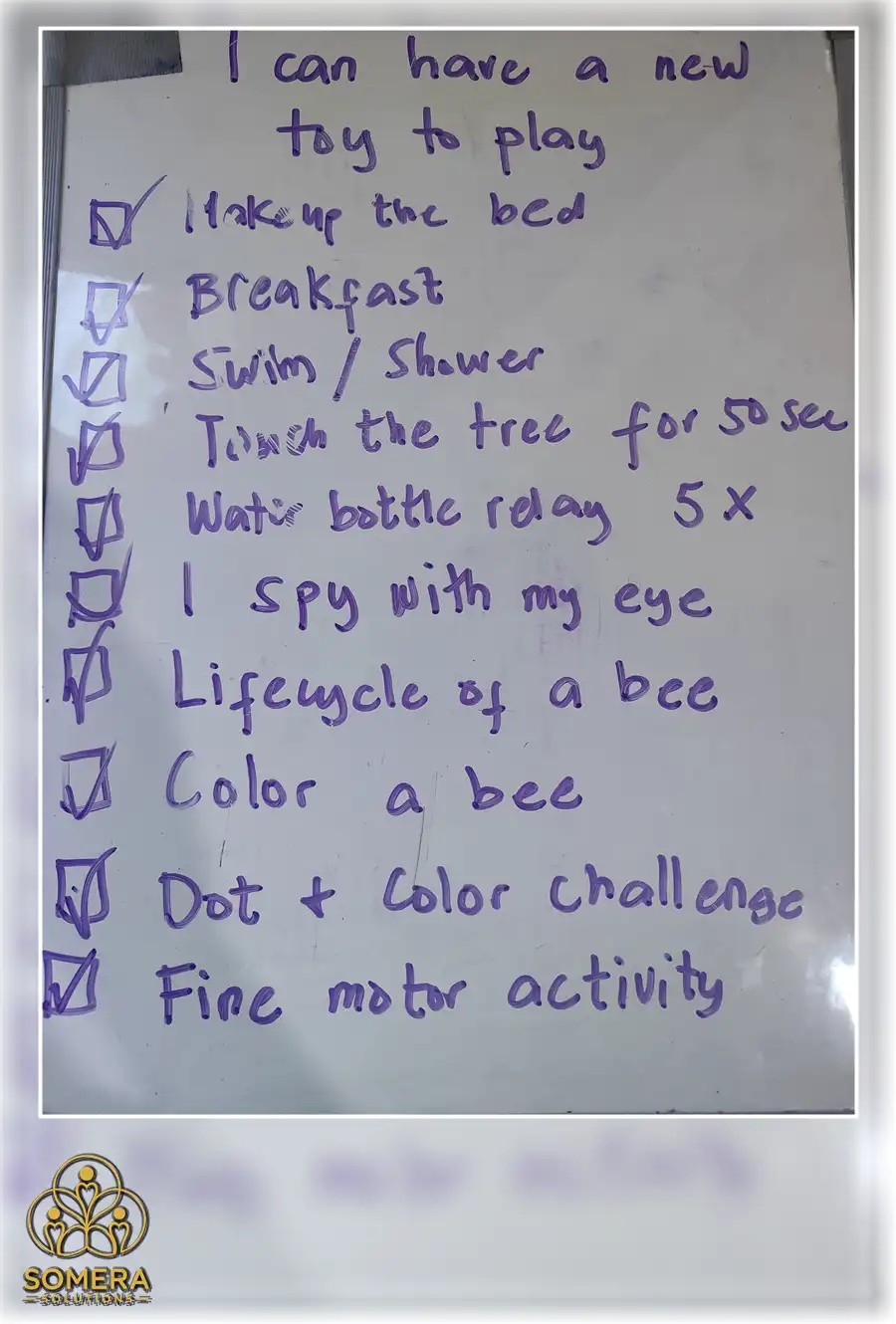
Our son loves them. They are part of his token economy. A token economy is a simple chart: when a child finishes a task, he earns a token, like a sticker, and later he trades the tokens for something he enjoys. The brain-boosting activity sits at the very bottom of his chart, so he knows it is coming, and he wonders which one it will be. He is excited for our morning sessions.
Is morning really the best time?
We chose mornings because they suit our family. Then we wondered what the research says. Here is what we found, and what we could not find.
- A 2025 study in Italy followed 102 students aged 12 to 13. They did school-based movement in the morning, at midday and in the afternoon. Morning sessions gave higher attention, working memory and alertness than afternoon sessions (Latino and colleagues, in the journal Children).
- A 2014 trial led by Betsy Hoza gave 202 children in Kindergarten to Grade 2 thirty minutes of active games before school for 12 weeks. Parents of children at risk for attention difficulties reported fewer ADHD symptoms and less oppositional behavior. Typical children improved too, so the authors called it a “do-no-harm” approach.
- A 2020 review of 11 randomized trials, with 346 children with ADHD or autism, found that regular physical activity improved executive function, especially self-control and flexible thinking. It did not clearly improve working memory (Zhang and colleagues).
- A small 2025 study by Nottingham Trent University researchers, reported in The Conversation, had 27 children aged 9 to 11 with ADHD do a 30-minute movement circuit in the afternoon. They did better on thinking tests that day, and the benefit was still there the next morning.
Now the honest part. We did not find a study that compares morning and afternoon in children like ours. These studies were about other children and about exercise in general, not about our activities. So we do not say that morning is the answer. We say the research leans toward morning, and the best time is the one your family can keep. For us, that is before lessons.
How can you start your morning?
You do not need equipment or a therapist. Choose a pattern from our images above and try it tomorrow morning:
- Move first. Do one movement your child enjoys, like an animal walk, the wheelbarrow walk or hop-hop-hop. One is enough.
- Choose a pattern from our images. Pick one: the pasta egg, the color-matching board, the letter patterns or the dot and color challenge. Do it before the pencil or the book comes out.
- Sit for it. Keep it short, a few minutes. Let your child stand, kneel or lie down at first if that helps. Stop while it is still fun.
- Settle, then start one short task. Sit for 20 seconds with hands on the lap, then begin one small task. Let your child stand, kneel or lie down if that helps at first. Our post on how to start home therapy shows how we pick one small goal at a time.
- Let your child look forward to it. Put the activity on a simple token chart, so there is a star or token to earn. Our son knows it is coming and wonders which one it will be. Our free guide is a gentle place to start, and our free printable tools include a token economy chart.
Movement should feel safe and happy. Never force it, and stop if your child is in pain or upset. If you are worried about your child’s movement, attention or learning, please talk to a licensed professional, like an occupational therapist or a doctor. Brain-boosting activities support what a professional advises. They do not replace it.
Our son kept moving, and for a long time we tried to stop it. Now we give the movement a job. One activity, one morning at a time. If you want to know more, join our Facebook group.
Common questions
Can a child who will not sit still learn to write and read?
Many can, with time and a gentler start. For our son, one short movement activity first helps him begin. If you are worried, please ask a licensed professional.
What is the best time of day for brain-boosting activities?
Research leans toward morning, but we found no study comparing times of day in children like ours. Choose the time you can keep.
Do brain-boosting activities replace therapy?
No. They support what a licensed professional advises, and they are something you can do at home.
Want a gentle next step?
Our free 14-day guide walks you through simple steps, one small day at a time.
Get the free guideRead next
- From Public School Plans to a Farm Classroom: How We Began
- How to Help Your Child Talk More at Home Without Feeling Lost

Iryne is a mama and the creative force behind Somera Solutions. With a background in engineering and over 10 years of technical writing, she shares simple, gentle steps for families supporting a child’s communication and early learning at home. She and her husband, Marvin, homeschool their son on their farm in Kiblawan, Davao del Sur, The Philippines.