
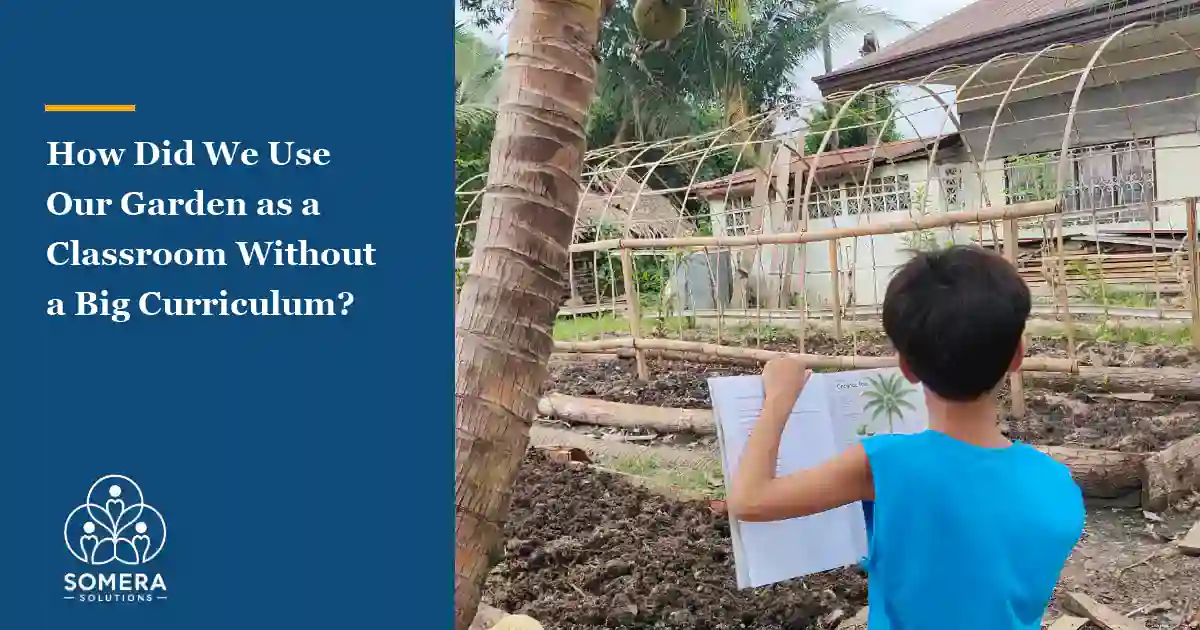
A regadera (watering can) and a garden bed are already a classroom.
We did not plan it that way. In fact, there was no big lesson plan and no stack of worksheets when we started homeschooling. There was a garden, a few coconut trees, and a little boy who has taught us more about learning than any book. This is how we use our garden as a classroom, and how you can start with yours.
Can a garden be a classroom? Yes. Our garden is our classroom. We started with coconut trees, then plants, and now our son weeds and waters every day at 5 PM. You do not need a big curriculum. Pick one thing already around you, start small, and let daily chores teach.
Why did we start with coconut trees?
We live in the province now. Our garden grows beside our home. A few minutes away, we are building a family farm with coconut trees. Coconuts are everywhere around us.
So when Marvin and I planned our son’s first-grade homeschooling year, we asked one simple question: What is already around us? The answer was the coconut trees. They became the first thing we taught him.
You may not have coconuts. But you have something. A mango tree, a banana plant, a pot of herbs, a patch of grass. Start with what is already near your door.
What did we do with the coconuts?
We tied the coconut lessons to nature study and science. He learned to name the parts of a coconut tree: the roots, the trunk, and the leaves. Our garden has dwarf coconut trees, so he can see them up close.
Then came a moment we still smile about. One of our trees has no fruit. He kept saying, “No coconut fruits, Mama, no coconut fruits,” even though the other trees had coconuts. One day, some mature coconuts fell to the ground. He picked one up, climbed the tree with no fruit, and set the coconut on one of its leaves. Now the tree looked as if it had fruit on top.
The funny part? His coconut was already brown, while the real coconuts around it were still green. He does not use many words, but we think he felt a little sad for that tree, and he found his own way to cheer it up.
We also did coconut activities at the table. He enjoyed all of it, from naming the parts of the tree, to coloring coconut trees, to reading a coconut poem.
Nothing here needed a big curriculum. A real tree, a real coconut, and a few table activities were enough for a good start.
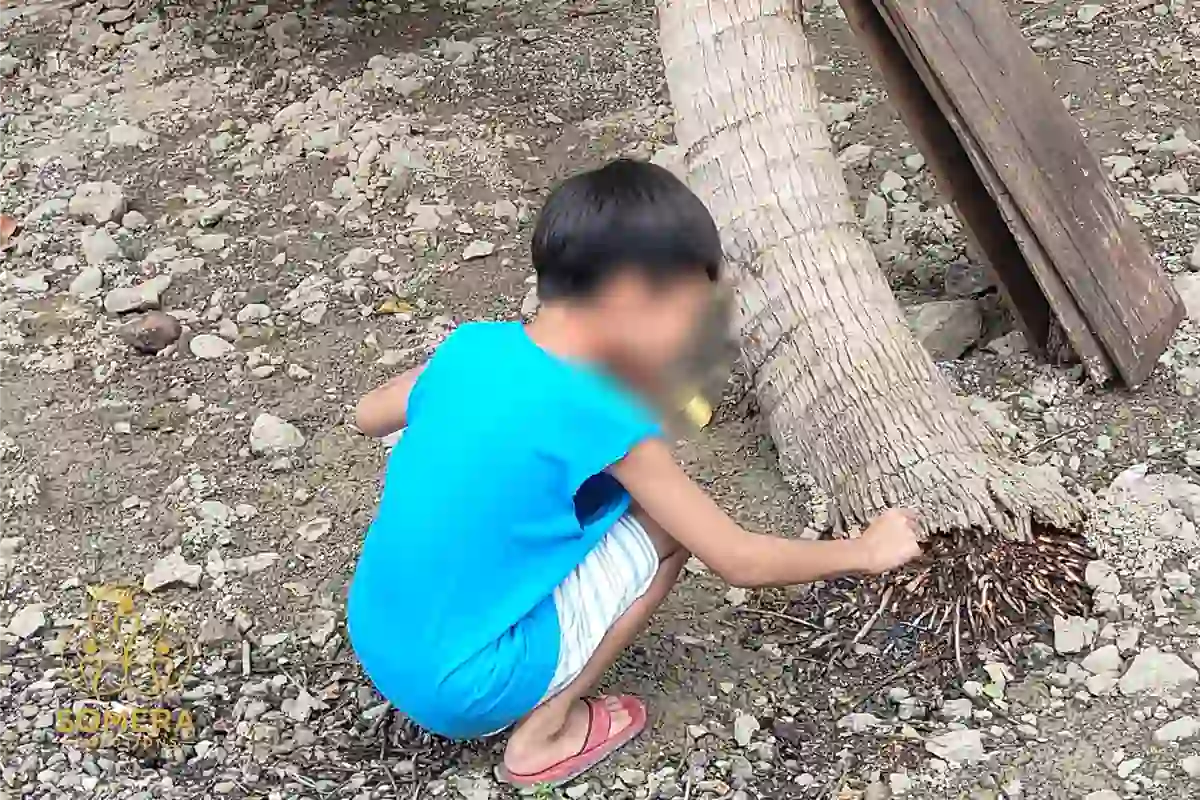
What does a garden chore teach?
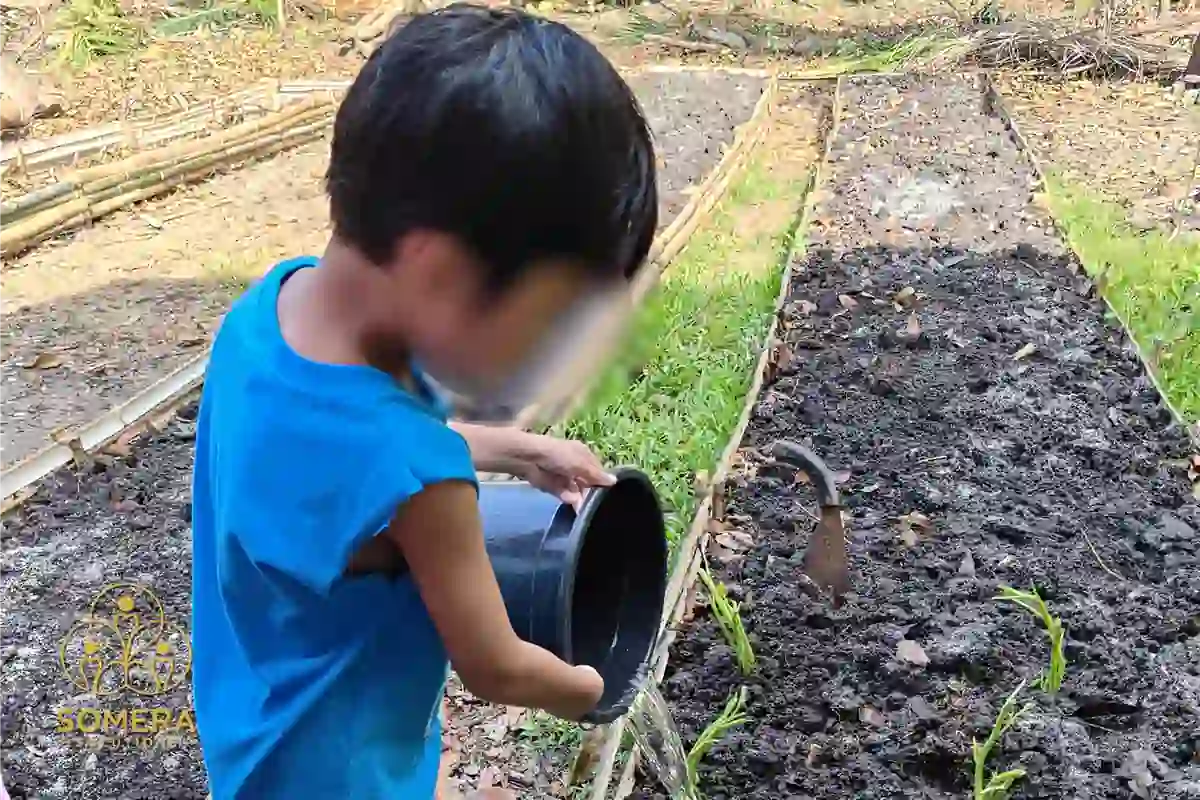
After the coconuts, we moved on to plants. Most of his garden jobs are simple. For example, he picks up weeds, and he waters the plants.
This is where our 5 PM habit comes from. We practice intentional screen time in our home. That means our son may play on the cellphone, but he is guided. There is a start and there is an end.
Now here is the part we love. At 5 PM, he stops. He needs only a little prompting, and sometimes a small reminder. Then he goes to the garden to water the plants, and he asks us to help. It is still working today.
We did not teach this with a speech. Instead, it grew out of a habit, one afternoon at a time.
Here is what we see in that one chore:
- Time. Five o’clock means something. The day has a shape.
- Responsibility. The plants are thirsty, and he is the one who helps.
- Asking for help. He asks, “Mama, help me?” That is communication, and it is real.
- Routine. The same thing, at the same time, in the same place.
- Care. Something living depends on him.
Here is the picture that stayed with us. A lesson is like fruit already hanging on the tree. We did not have to grow it somewhere else and bring it in. It was ripe in the chore, and all we had to do was pick it.
What small supports keep it going?
We added three small things. None of them is a big system.
- A token economy. We use a simple token system at home.
- A morning affirmation. Every morning, we say our daily affirmation together: “All is well. All the cells in my body are happy, healthy and full of light.” It is a gentle way to begin the day.
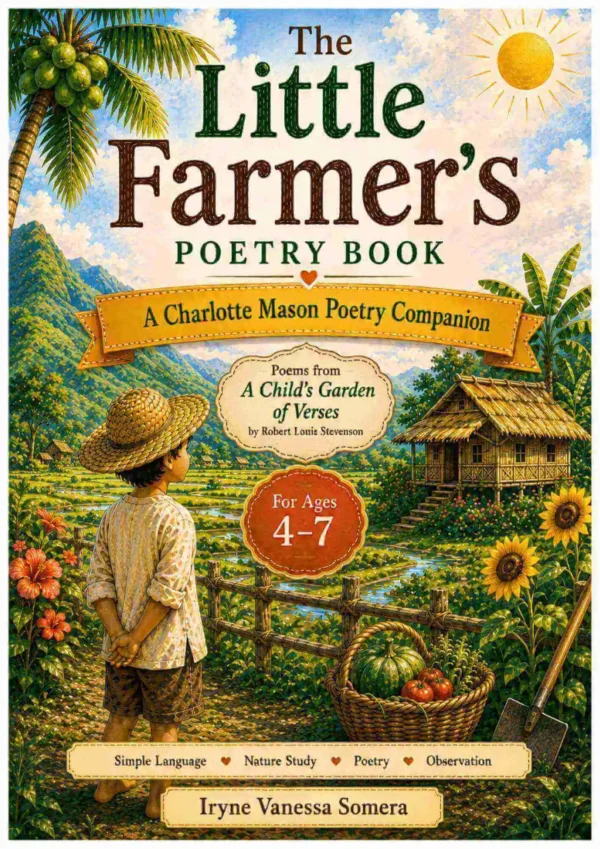
- A poem. We use The Little Farmer’s Poetry Book. It has a poem about coconuts. We also use the poem “The Gardener” for copywork and narration, and to introduce the idea of farming. One short poem can carry a whole morning.
Why does a daily chore work so well?
A chore is something real. It has a purpose that a child can see: the plant is thirsty, and the water helps. There is no pretend in it, so a child does not need to be told why it matters.
A chore is also repeated. The same watering, at the same time, again tomorrow. For a child who likes to know what comes next, that repeating is a comfort. It is also how a new word or a new skill finally sticks, because it comes back before it is forgotten.
And a chore is gentle. There is no test at the end, and nobody is waiting for the right answer. If he waters one plant and wanders off, the plant still got a drink.
How can you start with one pot or one garden bed?
You do not have to do all of this. So start small, with one pot or one garden bed.
- Step 1: Pick one pot or one garden bed. One is enough.
- Step 2: Pick one chore. Watering or weeding is a good one, because it comes back every day.
- Step 3: Ask one small question. “How many scoops?” or “What is this one called?”
- Step 4: Stay a few minutes. Then stop while it is still fun.
That is all. On days when we are tired, and we have those days too, five minutes is enough. A short, happy watering still counts as a lesson.
One more tip: let your child lead when they can. When our son asks for help, he is practicing a skill we hope he uses all his life. That is worth more than a perfect lesson.
What if you do not have a farm?
Then please do not feel left out. We live in Kiblawan, Davao del Sur, but a lesson does not need acres.
A pot on a windowsill works. So does a tin can with soil and a few seeds. Even a glass of water with a green onion in it works, and you can watch the roots grow.
If you plan to homeschool, check our homeschooling page. Garden lessons are one part of the day, and the requirements are a separate part. It helps to know both. If you would like to know the beginning of our story, you can read how we began homeschooling.
Want to see our garden and farm life? We share it on our YouTube channel, Somewhere in Kiblawan. And if you are not sure where to start with learning at home, our free guide has gentle steps in one place.
You do not have to buy a big curriculum to begin. In fact, you may already own a classroom. It might be a watering can and a pot of herbs.
Common questions
Do I need a farm to do this?
No. A few pots or a small bed is enough to begin.
How do I start homeschooling?
Start by checking what your school or DepEd requires. Garden lessons are one part of the day, and the requirements are a separate part. It helps to know both. Begin small, with one subject and one hands-on activity, and add more as your routine grows.
What can watering plants teach?
Counting scoops, naming plants, new words, taking turns, and patience.
Want a gentle next step?
Our free 14-day guide walks you through simple steps, one small day at a time.
Get the free guideRead next
- How to Help Your Child Talk More at Home Without Feeling Lost
- How to Teach Your Child to Blow Out a Birthday Candle Without Frustration

Iryne is a mama and the creative force behind Somera Solutions. With a background in engineering and over 10 years of technical writing, she shares simple, gentle steps for families supporting a child’s communication and early learning at home. She and her husband, Marvin, homeschool their son on their farm in Kiblawan, Davao del Sur, The Philippines.